

The science of extraction
The coffee-to-water ratio is the most important variable in your brew. It controls how many acids, sugars, and oils end up in your glass. If you get the math wrong, the coffee tastes flat or overly sharp regardless of how expensive the beans were.
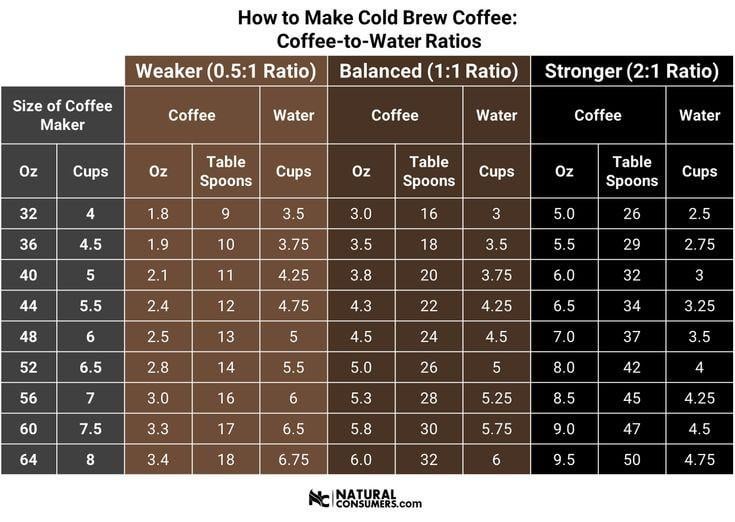
Different ratios dramatically impact the balance of acidity, sweetness, and body in your cold brew. A lower ratio, meaning more coffee, will usually yield a more concentrated, bolder brew with a heavier body. Conversely, a higher ratio, with more water, will produce a lighter, brighter, and more delicate cold brew. It’s a spectrum, and finding your sweet spot is key.
While 'perfect' is a subjective term, we’ll focus on science-backed starting points and the principles that allow you to tailor the brew to your exact preferences. A poorly chosen ratio can easily ruin even the highest-quality coffee beans, while a well-executed ratio can elevate even average beans to something special. It’s a foundational element of great cold brew.
Standard ratios to start with
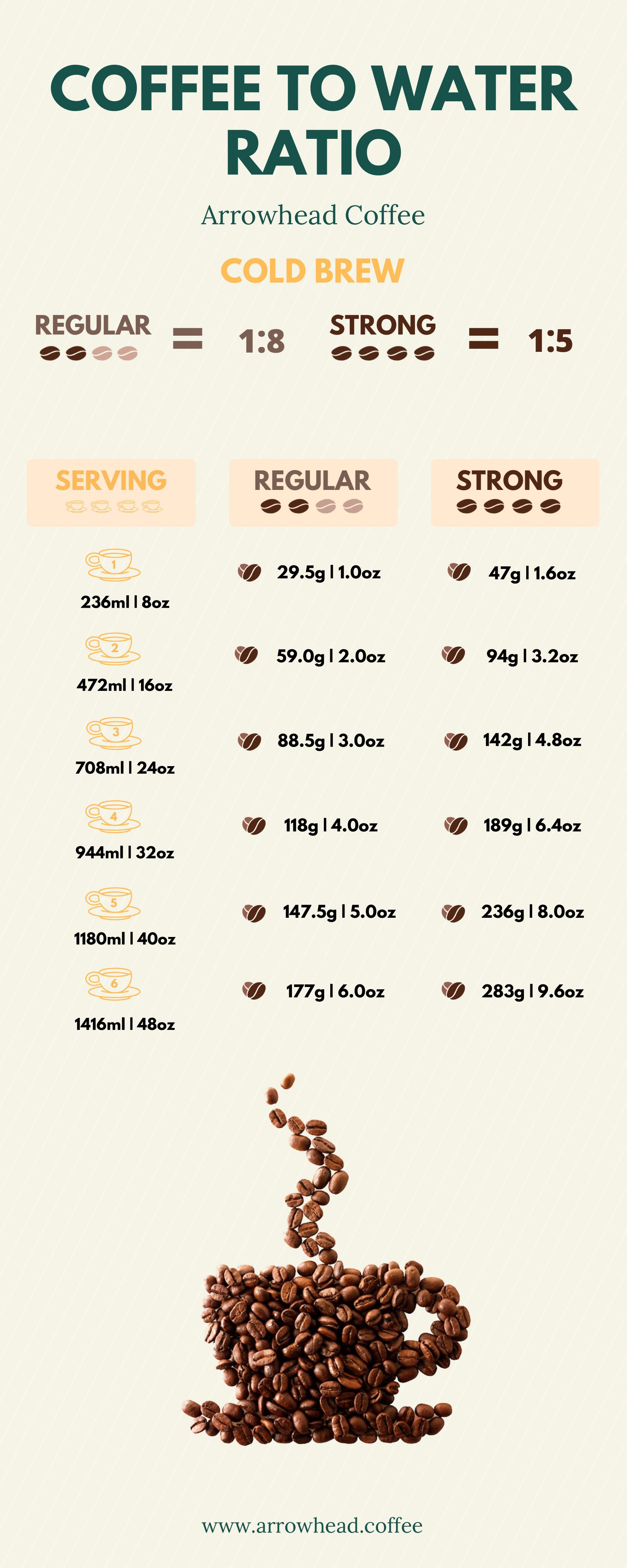
A 1:8 coffee-to-water ratio is a fantastic all-around starting point for cold brew. This translates to 100 grams of coffee grounds for every 800 grams of water. It’s a balanced ratio that generally produces a strong, flavorful concentrate suitable for dilution. Many people find this is a good baseline to begin their experimentation.
Moving towards a 1:10 or 1:12 ratio will result in a less concentrated brew. A 1:10 ratio uses 100g of coffee to 1000g of water, while 1:12 uses 100g of coffee to 1200g of water. These higher ratios are good if you prefer a ready-to-drink strength or if you’re using a particularly strong or flavorful bean. They'll also be slightly easier on the palate.
It's absolutely critical to measure ingredients by weight rather than volume. A cup of ground coffee can vary significantly in weight depending on the grind size and bean density. Using a kitchen scale ensures consistency and accuracy. I’m not sure people realize how much difference a few grams can make when you’re aiming for precision. A small digital scale is a worthwhile investment for any serious cold brew enthusiast.
Concentrate vs ready-to-drink
You need to decide if you want a concentrate or a ready-to-drink bottle. A concentrate is a heavy base you dilute with water or milk later. Ready-to-drink is brewed at a lower strength so you can pour it straight over ice.
Concentrate ratios typically fall between 1:4 and 1:6, according to many brewers, as noted on Facebook discussions about optimal ratios. This means 1 part coffee to 4-6 parts water. Ready-to-drink ratios are closer to traditional brewed coffee strengths, often around 1:8 or 1:10. This distinction is where a lot of confusion arises.
The choice between concentrate and ready-to-drink depends on your preferences. Concentrate offers convenience and allows for flexible dilution, while ready-to-drink provides an immediate, grab-and-go option. Concentrate also stores better, as dilution introduces more water and thus a greater chance of spoilage. Weigh the pros and cons to decide which approach suits your lifestyle.
- Concentrate: 1:4 to 1:6 ratio, requires dilution, longer shelf life
- Ready-to-Drink: 1:8 to 1:10 ratio, immediate consumption, shorter shelf life
Cold Brew Ratio Comparison: Concentrate vs. Ready-to-Drink (2026)
| Ratio Range | Intended Use | Dilution Required | Typical Brew Time | Flavor Profile |
|---|---|---|---|---|
| 1:4 to 1:8 (Coffee:Water) | Cold Brew Concentrate | Yes, typically 1:1 to 1:3 with water or milk | 12-24 hours | Bold, intense, and syrupy |
| 1:10 to 1:16 (Coffee:Water) | Ready-to-Drink Cold Brew | Minimal to none, can be enjoyed directly over ice | 12-24 hours | Balanced, smooth, and approachable |
| 1:5 (Coffee:Water) | Strong Concentrate – for cocktails/desserts | Significant dilution required, adjust to taste | 18-24 hours | Very Bold, rich, and complex |
| 1:12 (Coffee:Water) | Mild Ready-to-Drink – for everyday consumption | May benefit from a splash of water or milk, depending on preference | 16-20 hours | Delicate, clean, and refreshing |
| 1:6 to 1:10 (Coffee:Water) | Versatile Concentrate - adaptable to various preferences | Dilution recommended, starting with 1:2 and adjusting | 12-24 hours | Balanced, allowing for customization of strength |
| 1:14 to 1:18 (Coffee:Water) | Light-Bodied Ready-to-Drink | Typically ready to drink, but can be enhanced with milk or cream | 18-24 hours | Subtle, nuanced, and easy-drinking |
Illustrative comparison based on the article research brief. Verify current pricing, limits, and product details in the official docs before relying on it.
Adjusting for roast and bean type
The type of coffee bean you use significantly influences the ideal cold brew ratio. Darker roasts, for instance, tend to be more soluble and can easily become over-extracted, resulting in a bitter brew. A slightly higher water ratio (e.g., 1:9 or 1:10) can help mitigate this.
Lighter roasts are harder to extract. I usually drop the ratio to 1:7 or 1:8 to pull out those floral notes. If you use a standard 1:10 on a light roast, it often tastes thin and papery.
Bean density also plays a role. Denser beans, like some Sumatran varieties, may require a slightly longer brew time or a slightly lower ratio to achieve optimal extraction. It’s a nuanced interplay, and experimentation is key. I’ve found that Ethiopian Yirgacheffe needs a different ratio than a Sumatran Mandheling to really shine.
How brew time changes the math
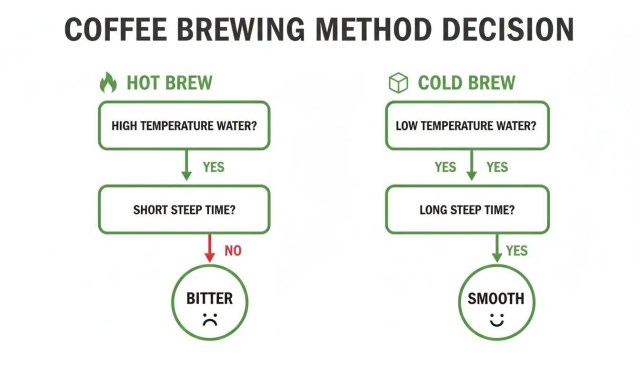
The coffee-to-water ratio and brew time are not independent variables; they work in tandem. A longer brew time can effectively compensate for a lower coffee ratio, and vice versa. If you want to use a higher water ratio but still achieve a strong brew, simply extend the brew time.
Generally, a brew time of 12-24 hours is recommended for cold brew. Shorter brew times (12-16 hours) are better suited for higher ratios, while longer brew times (18-24 hours) can be used with lower ratios. However, exceeding 24 hours can lead to over-extraction and undesirable flavors.
It’s a balancing act. If you find your brew is too weak, try reducing the water ratio or increasing the brew time. If it’s too strong or bitter, increase the water ratio or shorten the brew time. Small adjustments can make a big difference. You're looking for harmony between ratio and time.
Dialing in by taste
Ultimately, the 'perfect' cold brew ratio is the one that tastes best to you. Don't be afraid to experiment and adjust the ratio based on your personal preferences. The best way to find your ideal ratio is to brew small batches with different ratios and meticulously document your results.
Keep a brewing journal to track your experiments. Note the coffee-to-water ratio, brew time, bean type, and your tasting notes for each batch. This will help you identify patterns and refine your technique. Tasting is the most important part of the process.
Learn to identify the signs of under-extraction and over-extraction. Under-extracted cold brew often tastes sour or acidic, while over-extracted cold brew tastes bitter or astringent. Adjust the ratio accordingly – lower the ratio for under-extraction and increase it for over-extraction. It can be intimidating, but it's the most rewarding part.
- If it tastes sour or sharp, you have under-extracted. Use more coffee next time.
- If it tastes bitter or like ash, you have over-extracted. Add more water to the ratio.
Ratios in Action: Recipe Standouts
Let’s put these ratios into practice with a few specific recipes. First, a classic, strong cold brew concentrate: 150g coarse ground coffee to 600g filtered water (1:4 ratio). Brew for 18-20 hours. This is perfect for adding to milk or making iced lattes.
Next, a ready-to-drink Ethiopian Yirgacheffe cold brew: 100g coffee to 800g filtered water (1:8 ratio). Brew for 16-18 hours. Yirgacheffe’s floral notes shine with this lighter ratio. Use a medium-fine grind.
Finally, a Vanilla Sweet Cream Cold Brew: Start with 120g coffee to 720g water (1:6 ratio), brewed for 24 hours. Dilute 4oz concentrate with 8oz milk. Add 1oz vanilla sweet cream (recipe: 1/2 cup heavy cream, 1/4 cup milk, 2 tbsp vanilla syrup, 1 tsp powdered sugar, whipped). This is a decadent treat.

No comments yet. Be the first to share your thoughts!